Author: kristen
It’s been a big 15 months for VET. New enrolment data, a permanent shift in funding policy, tighter rules for international delivery and a new set of compliance standards have all landed in quick succession. Any one of these would be worth paying attention to. Together, they’re changing the conditions private RTOs work in.
To save you piecing it together, here’s what’s changed, what each change covers, and the dates worth putting in your calendar.
The 2025 enrolment data: government funding is pulling back fastest
NCVER’s latest Total VET Activity release recorded 2,804,190 enrolments in 2025, down 5.2%. As our NCVER 2025 analysis found, that’s the steepest annual fall in the seven-year series, and even sharper than the COVID-affected drop in 2020.
But the headline number doesn’t tell the whole story. The fall wasn’t even across funding types:
– Government-funded enrolments: down 8.0%
– Domestic fee-for-service: down 0.8%
– International fee-for-service: down 5.0%
Government funding is retreating fastest. Fee-for-service isn’t growing, but it’s holding far steadier. For breakdowns by age, qualification level and state, see the full analysis.
Free TAFE is here to stay
Free TAFE no longer has an end date. The Department of Employment and Workplace Relations confirms the Government has committed more than $1.6 billion to 2034-35 to fund at least 100,000 Free TAFE and VET places a year from 2027, backed by the Free TAFE Act 2025.
Places will be prioritised for people who typically face barriers to study, in high-demand fields of national and state priority.
The real change here is certainty. Free TAFE is moving from a series of funding agreements to a permanent part of the VET system. That means private RTOs can plan around it rather than wait to see if it continues.
Two CRICOS changes to know about
New CRICOS applications are paused for 12 months
From 19 May 2026 until 19 May 2027, providers can’t apply to ASQA for initial CRICOS registration or to add new courses to an existing registration. The Department of Education fact sheet covers the full scope.
The pause responds to integrity concerns, including low-quality or non-genuine providers entering the market and growth concentrated in certain course areas. Government schools, state or territory-owned VET providers and Table A providers are exempt.
Just as important is what the pause doesn’t touch:
– Delivery mode changes, duration changes, renewals and administrative amendments to existing CRICOS registrations can all still go ahead.
– Domestic RTO registration and domestic scope applications aren’t affected at all.
One course is closed to new international students
The Assistant Minister for International Education has named the BSB80120 Graduate Diploma of Management (Learning) for automatic suspension and cancellation under the ESOS Act. It’s part of broader action to protect the integrity of Australia’s student visa program.
ASQA confirms that from 5 October 2026, providers can’t do any of the following for this course:
– Issue new Confirmations of Enrolment
– Enrol new overseas students
– Start overseas students who haven’t yet commenced
Students already studying can finish, and domestic delivery carries on as normal.
The measure applies to this specific course only, not to graduate diplomas in general. But it’s the first use of the government’s new power to suspend or cancel specific courses for overseas students. The power exists, and it’s now been used.
Key dates at a glance
- 1 July 2025: 2025 Standards for RTOs took effect
- 19 May 2026: 12-month pause on new CRICOS applications commenced
- 5 October 2026: GDML closed to new international students
- 1 January 2027: ongoing Free TAFE places begin under the Free TAFE Act
- 19 May 2027: CRICOS application pause scheduled to end
What this means for private RTOs
Government-funded activity is contracting, Free TAFE is permanent, and international delivery is under closer regulatory scrutiny. Domestic fee-for-service remains the most stable part of the market.
With that in mind, here are three questions worth asking now:
How exposed is your enrolment mix? If a large share of your enrolments depends on government-funded places, the NCVER 2025 data is a prompt to look at how many of your courses rely on funded places.
Are your international plans still on track? If you were planning to register for CRICOS or add new courses before May 2027, now’s the time to revisit your timelines. If the Graduate Diploma of Management (Learning) is in your scope, check how the 5 October changes apply to your current and incoming students.
Is compliance part of everyday practice? The 2025 Standards connect requirements directly to outcomes. Providers who can show quality in how they operate day-to-day will be better placed than those relying on policy documents alone.
The next few months will bring more clarity. The Graduate Diploma of Management (Learning) ban takes effect, Free TAFE moves to a permanent footing, and the CRICOS pause approaches its end date. We’ll keep tracking each development and share what it means for providers as it happens.
Need help with your student acquisition efforts? Get in touch.

Kristen Michaelides
Content Marketing Mananger
Australian VET enrolments dropped 5.2% in 2025, down to 2,804,190. That’s the steepest annual fall in the seven-year series and even sharper than the COVID-affected drop in 2020. But the headline number hides the real story. This isn’t an even pullback. It’s a contraction concentrated in specific corners of the market, while other corners are still growing. Here are the key takeaways.
1. Government funding is driving most of the fall
Government-funded enrolments dropped 8.0% in 2025. Domestic fee-for-service activity held far closer to flat, down just 0.8%. International fee-for-service fell 5.0%. Government funding is retreating fastest, and fee-for-service, while not growing, is proving the far more stable market.

2. Growth is coming from younger students. Everyone else is pulling back.
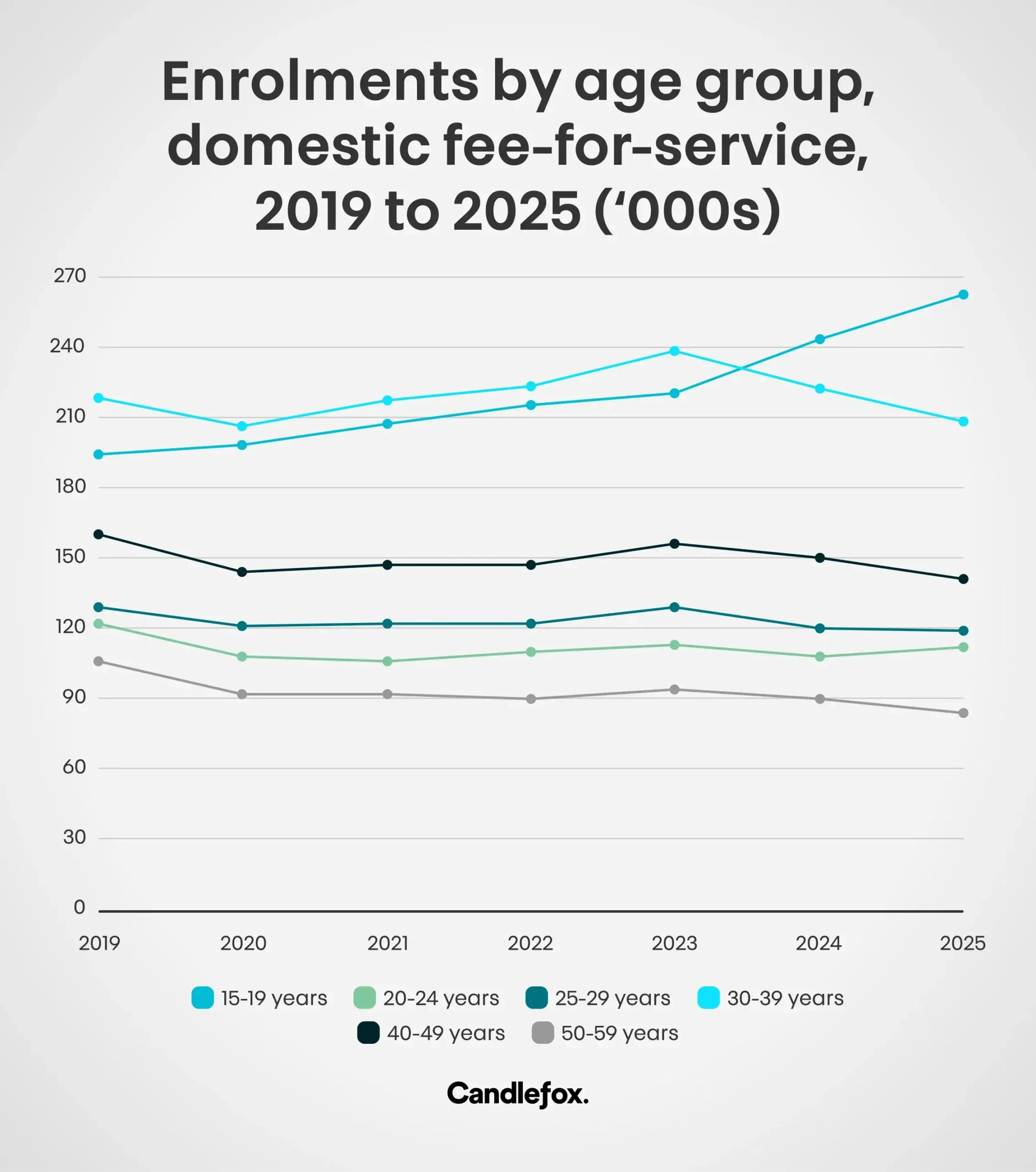
15-to 19-year-olds were the only age group to grow in 2025, up 2.5%. 30-to 39-year-olds fell 9.9%, 40- to 49-year-olds fell 10.7%, and 50- to 59-year-olds fell 10.9%. If your enrolment strategy leans on career changers and upskillers in their 30s and 40s, that’s the exact cohort pulling back hardest.
| Age (domestic fee-for-service) | 2019 | 2025 | 2019 to 2025 |
|---|---|---|---|
| 15 to 19 | 194,910 | 262,905 | +34.9% |
| 20 to 24 | 122,585 | 113,125 | -7.7% |
| 30 to 39 | 219,135 | 208,710 | -4.8% |
| 40 to 49 | 161,245 | 141,855 | -12.0% |
| 50 to 59 | 107,115 | 85,065 | -20.6% |
3. Certificate III and IV qualifications are shrinking
Certificate III fell 7.7% in 2025, and Certificate IV fell 15.4%. Zoom out to the full seven years, though, and the story splits by funding source. Across all funding, Certificate III is actually up 4.9% since 2019, a correction back toward trend. Within domestic fee-for-service specifically, it’s fallen every year since 2019 and is down 7.6% over that period: a genuine multi-year decline, not a one-year correction. Diploma and above tell the opposite story. Diploma across all funding is up, and across domestic fee-for-service is mostly flat. Advanced diploma grew 11.3%, and Graduate diploma grew 39.4%.
| All funding | 2019 | 2025 | Change |
|---|---|---|---|
| Certificate III | 948,920 | 994,985 | +4.9% |
| Certificate IV | 464,360 | 459,700 | -1.0% |
| Diploma | 344,325 | 359,605 | +4.4% |
| Domestic fee-for-service | 2019 | 2025 | Change |
|---|---|---|---|
| Certificate III | 315,715 | 291,875 | -7.6% |
| Certificate IV | 191,000 | 181,620 | -4.9% |
| Diploma | 109,450 | 110,050 | +0.5% |

4. Training packages are moving in different directions
Among domestic fee-for-service qualifications, Community Services fell 17.4%, more than every growing package combined managed to gain. Transport and Logistics fell 28.0%, and Training and Education fell 32.5%. On the other side, Financial Services grew 15.5%, Construction grew 8.5%, and Business Services grew 4.6%.
5. Victoria overtook NSW, but the more useful shift happened years ago
NSW fell 10.9% in 2025 and dropped out of the top spot nationally for the first time in the series. Victoria now leads, even though its own enrolments fell 3.6%, simply because NSW fell further. That ranking change is largely a government funding story: NSW’s fall is concentrated in publicly funded places, down close to 55,000 in a single year.

| State (all funding) | 2019 | 2023 | 2024 | 2025 | 2024 to 25 |
|---|---|---|---|---|---|
| New South Wales | 651,915 | 708,040 | 660,030 | 588,040 | -10.9% |
| Victoria | 602,250 | 624,895 | 647,915 | 624,595 | -3.6% |
| Queensland | 604,155 | 625,760 | 618,225 | 609,310 | -1.4% |
| Western Australia* | 229,915 | 263,165 | 282,450 | 256,850 | -9.1% |
| South Australia | 126,025 | 133,790 | 135,370 | 138,325 | +2.2% |
*Western Australian figures for 2025 have been affected by reporting changes associated with the transition to non-accredited literacy and numeracy support (‘foundation skills’) introduced in January 2025. This change impacts comparability with previous years at the overall program enrolment level, and specifically amongst short course enrolments. See table below.
| Western Australia | 2019 | 2020 | 2021 | 2022 | 2023 | 2024 | 2025 |
|---|---|---|---|---|---|---|---|
| As reported | 229,915 | 232,285 | 251,365 | 249,230 | 263,165 | 282,450 | 256,850 |
| YoY | +1.0% | +8.2% | -0.8% | +5.6% | +7.3% | -9.1% | |
| Excl. gov short courses | 210,585 | 208,815 | 220,900 | 221,335 | 234,005 | 251,275 | 249,890 |
| YoY | -0.8% | +5.8% | +0.2% | +5.7% | +7.4% | -0.6% |
Looking at fee-for-service specifically, and a different, older shift shows up. Queensland has led the fee-paying market every year since 2019. NSW slipped to third back in 2021, four years ago, and its fee-paying volume is now 28% below Queensland’s. Victoria’s fee-paying enrolments have grown 15% since 2019, while NSW’s have fallen 18% over the same period.
| Funding source | 2019 | 2023 | 2024 | 2025 | 2019 to 2025 |
|---|---|---|---|---|---|
| Government | 1,439,595 | 1,561,505 | 1,559,205 | 1,433,940 | -0.4% |
| Domestic fee-for-service | 974,540 | 994,520 | 976,380 | 968,285 | -0.6% |
| International fee-for-service | 270,110 | 324,730 | 381,355 | 362,210 | +34.1% |
What this means for your RTO
Certificate III or Certificate IV, and government-funded training across Community Services or Training and Education competes in the fastest-shrinking part of the market. Whereas Financial Services, Construction, or higher-level qualifications have a real tailwind.
The adult career changer market is contracting, and fee-for-service is the stable ground right now, not the growth engine. Student recruitment is also likely to pay off more in Queensland and Victoria than in NSW, where the fee-paying base has been eroding since 2021.
Ready to grow your enrolments? Get in touch with Candlefox to see how we can help you reach more of the students actively searching for their next course.
Want the full breakdown? Download Candlefox’s NCVER 2025 report for a deeper look at what’s driving the numbers.
Kristen Michaelides
Content Marketing Mananger
Kristen Michaelides is Content Marketing Manager at Candlefox, the company behind GabbyAI. She writes about AI adoption, enrolment performance, and the operational realities facing RTOs and education providers today.
A lead comes in at 9 pm on a Friday. No one calls until Monday morning. By then, it’s 60 hours old and gone cold.
The usual fix is speed to lead. Call faster, and you’ll catch the lead before it goes cold. That assumption has shaped most enrolment strategies for years, and it’s only half right.
We analysed 99,184 call records and 15,434 leads from our own network data, from February to May 2026, and found something that runs against how most RTOs think about follow-up. Speed matters, but only for a narrow window. And no matter how fast or how often a team calls, a meaningful share of leads were never going to pick up the phone at all…
This is what the data actually shows, and what it means for your enrolment team.
The topline stats
– 39% of leads are never reached, no matter how many times they’re called
– 73% of all successful contact happens within the first two attempts
– A callback within four hours of a missed call performs on par with a first attempt. Waiting longer cuts that rate roughly in half
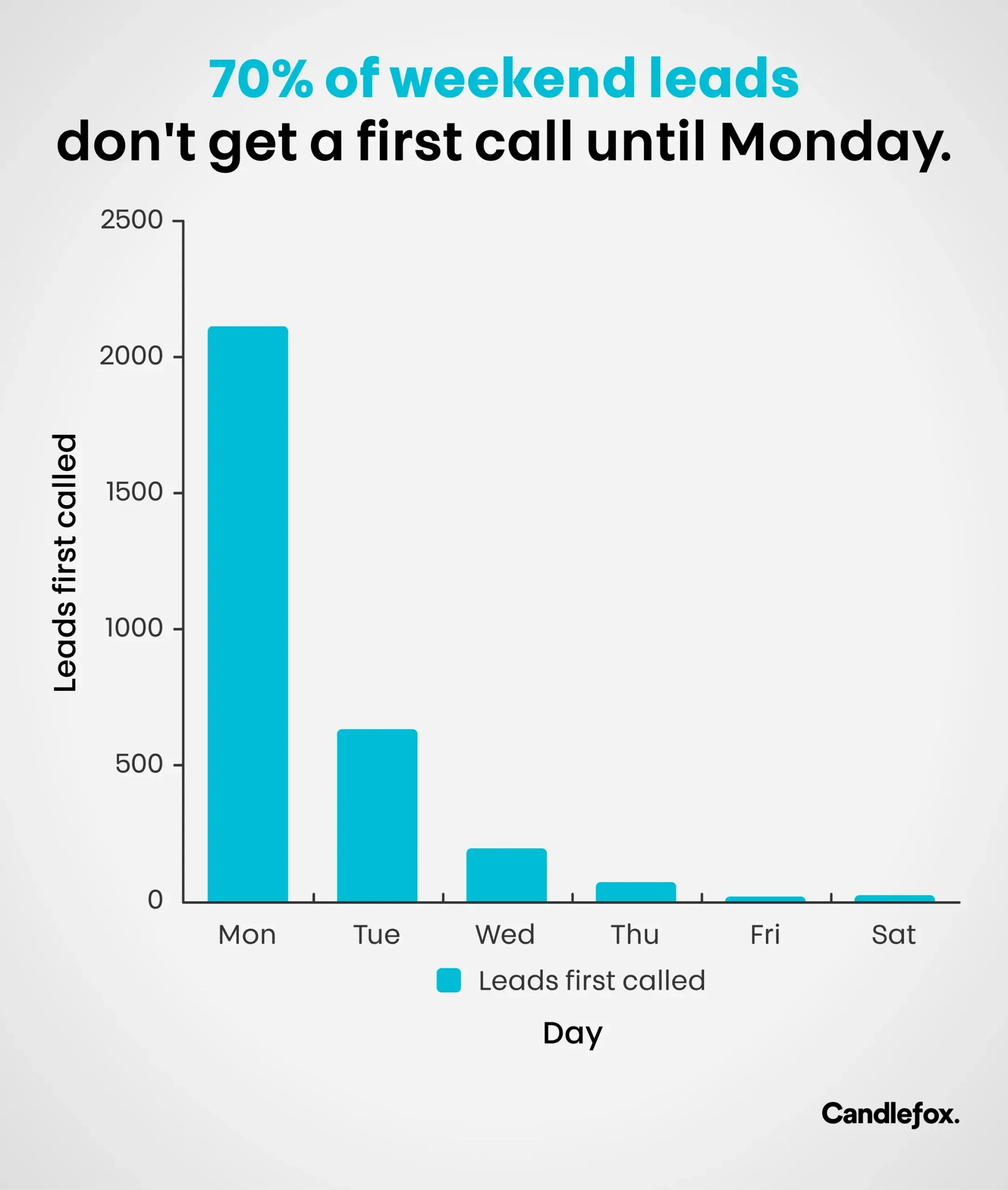
– 59% of leads arrive outside business hours, yet 70% of weekend leads don’t get a first call until Monday
Here’s what the data says about where that gap comes from, and what it means for your team.
Two numbers, two different questions
Before we jump into the findings, here are the two main data points we measured in the study:
- Contact rate is how many dials connect. It’s a dialling efficiency metric: how productive is each attempt?
- Contact penetration is how many leads get reached at all, across every attempt made. It’s a coverage metric: how much of the pool are we actually reaching?
The key findings
1. There’s a ceiling on coverage and more calls won’t break it
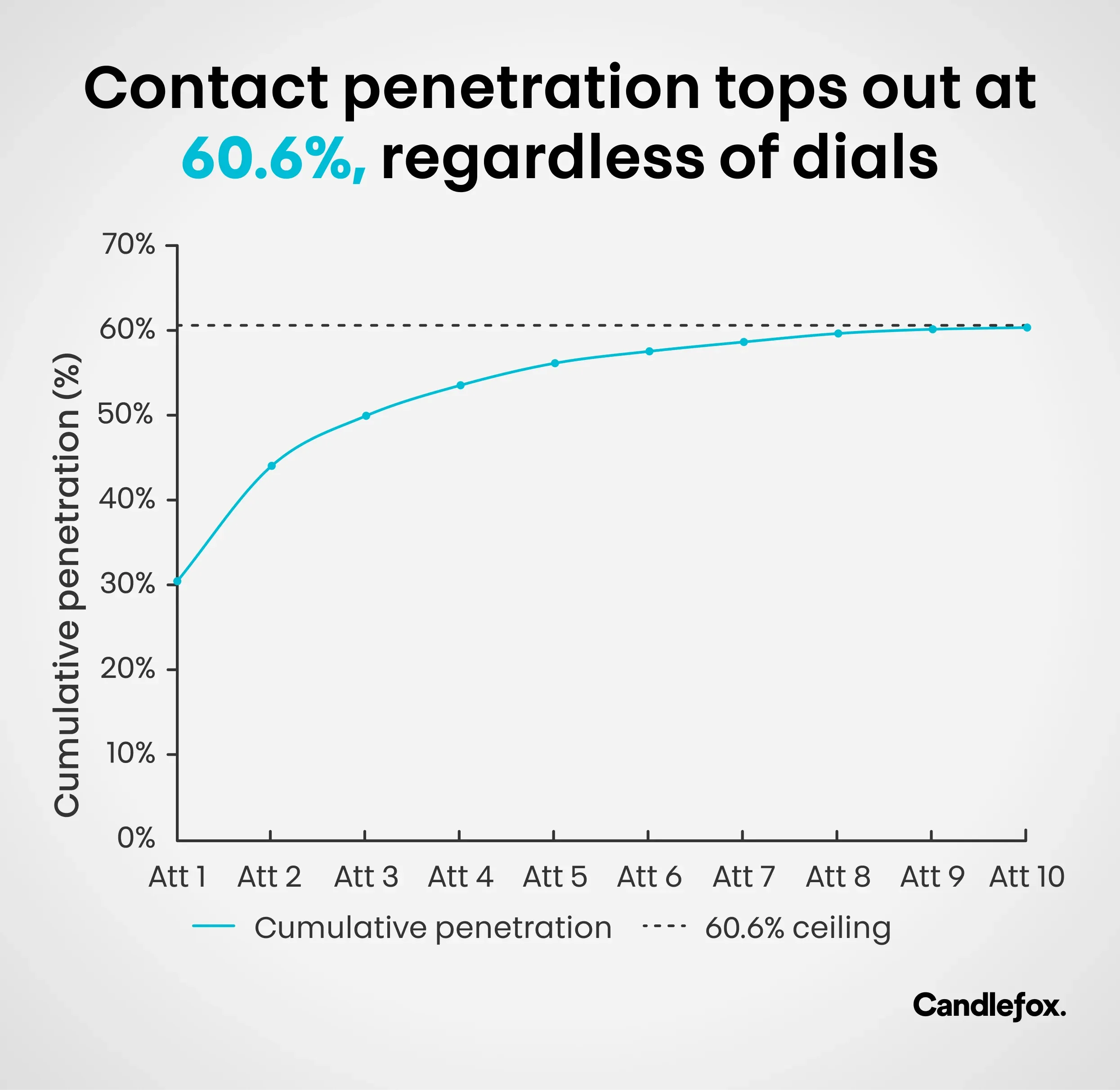
Contact penetration tops out at 60.6%, no matter how persistent the follow-up. That means roughly 39% of leads are never reached, regardless of how many times they’re dialled.
Most of that contact happens early. 73% of all contact ever made with a lead happens within the first two attempts, and attempts six through ten add just 3% more. Beyond a certain point, more dialling doesn’t buy more coverage.
2. It’s not the lead age that kills contact rate, it’s attempt number
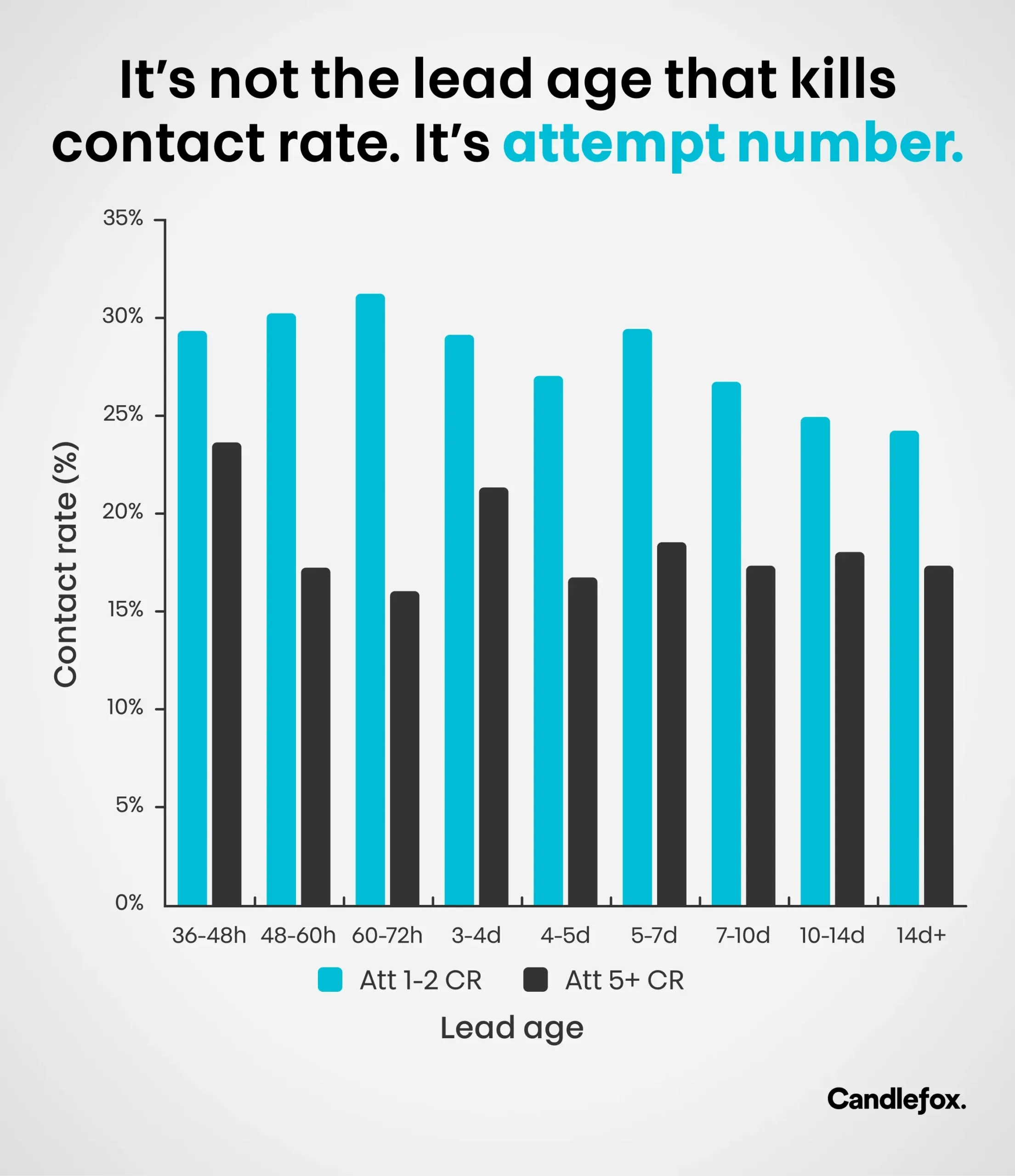
Hold the attempt number constant, and contact rate by age flattens to a stable 23 to 33%, regardless of how old the lead is. What looks like an age effect is really an attempt effect: young leads are usually on attempt one or two, while older leads have already burned through several. Attempt number, not age, is doing the work.
3. Speed matters, but the window is much smaller
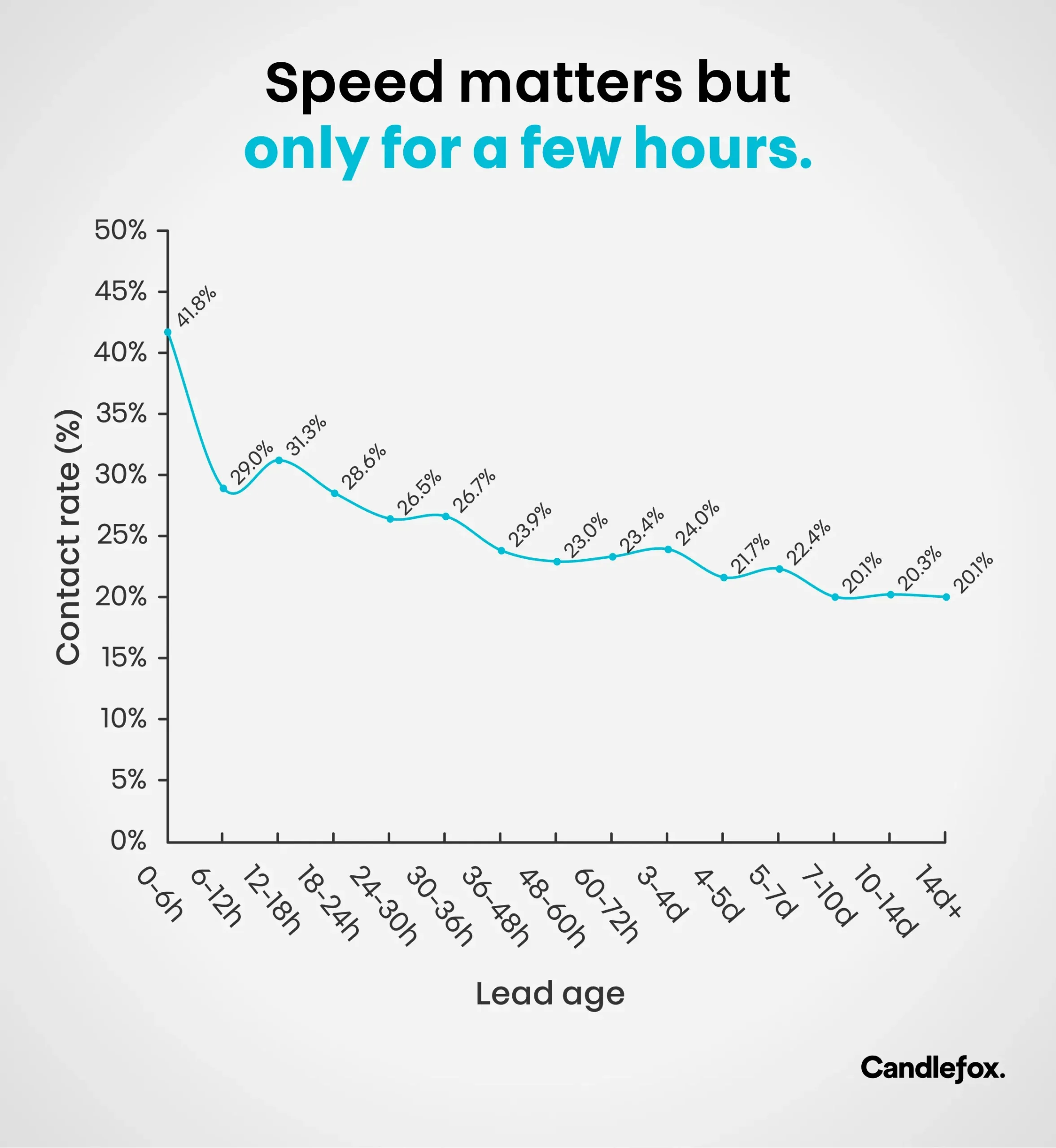
Contact rate peaks fast and fades fast: 41.8% in the first six hours after a lead arrives, plateauing at roughly 20% by hour five and staying flat from there.
Once a lead is reached, though, speed stops mattering for conversion. It holds steady at 12 to 14%, whether that first contact happens in hour one or day five. In other words, speed determines whether you reach the lead at all, not whether they convert once you do.
4. The best callback window is barely being used
A callback within four hours of a no-answer gets you a 32% contact rate. It’s statistically identical to a first attempt. Wait longer, and it drops to 17-20%.
Despite that, only about 19% of callbacks currently land inside the four-hour window. The median gap between call attempts is 22.9 hours, closer to one call per lead per day than the three-a-day cadence many teams assume they’re running.
5. Weekends are a coverage gap, not a demand gap
Weekend leads convert at roughly the same rate as in-hours leads when they’re reached in time (7.98% within 12 to 24 hours, versus a 7.97% in-hours average). The demand is clearly there.
The coverage isn’t. Leads arriving outside business hours make up 59.4% of the pipeline, the majority of it, yet 70% of weekend leads don’t get a first call until Monday. By then, they’re 24 to 66 hours old.
Two populations, two different fixes
Put all of this together, and the “unreachable” leads split into two distinct groups, each needing a different response.
| Timing-solvable | Channel-resistant | |
|---|---|---|
| Who they are | OOH and weekend leads who are reachable, just not called in the right window. | Roughly 39% of leads who won’t answer an unknown number, regardless of timing |
| What the data shows | Contact rate for OOH leads called within 6 hours (64.9%) nearly matches in-hours performance | Contact penetration is flat at roughly 61% from attempt one through ten |
| The fix | Faster, better-timed calling | A different channel like SMS, email or WhatsApp to capture channel preference and keep the lead warm. |
The takeaway
None of this is solved by working harder or dialling more. A narrow four-hour window carries disproportionate weight, and a meaningful share of the pipeline needs a different channel entirely to be reached at all.
For an enrolment team, the fix isn’t “call more.” It’s calling smarter within the first two attempts, hitting the four-hour callback window without relying on agent memory, and routing channel-resistant leads to SMS or email instead of a fifth wasted dial. Get those three things right, and coverage moves without adding a single extra hour of agent time.
Where GabbyAI fits
Closing this exact gap, between when a lead arrives and when someone finally reaches them, is one of the core problems our new AI enrolment agent, GabbyAI, is built to solve:
- Catches leads the moment they arrive, including out of hours and on weekends, so the 60-hour-old Monday callback stops happening
- Triggers callbacks within the four-hour window automatically, no longer dependent on an agent remembering to circle back
- Flags channel-resistant leads for SMS or email follow-up instead of wasting another attempt on a channel that isn’t working for that lead
If inconsistent lead flow is costing you enrolments, the fix likely isn’t more effort from your team. It’s better timing and the right channel for the right lead.
Curious to learn more about GabbyAI?

Meghan Fernandes
Junior Content Specialist
Meghan Fernandes is a Content Writer at Candlefox, the team behind GabbyAI. Her work keeps RTOs and education providers informed on industry trends and information, offering useful insights on AI adoption and enrolment performance.
The Australian Government released its first report on AI and the labour market and it’s worth every RTO’s attention. Not because it confirms the AI job apocalypse everyone keeps predicting. It doesn’t. But because of what it reveals about where the next wave of student demand might come from.
What did the report actually find?
The short version: AI hasn’t caused widespread job losses in Australia yet. Unemployment remains low, and the labour market is holding up by historical standards.
But there are early signals worth watching. Employment in occupations considered most exposed to AI, including telemarketing, advertising and accounting roles, grew by 5.6% between November 2022 and February 2026. Less-exposed occupations grew by 9.5% over the same period. After accounting for pre-existing trends, the report estimates AI-exposed occupations now employ around 2% fewer people than expected.
The government is careful to note this isn’t proof of AI-driven job losses. Growth in these occupations was already slowing before ChatGPT arrived. Still, the direction is clear enough to take seriously.
Why are hands-on, vocational roles more resilient?
The occupations the report flags as least exposed to AI are largely trades, aged care and other vocational, hands-on roles. These are jobs built on physical skill, judgement and human connection, exactly the things AI can’t replicate.
The report also found that people in more exposed occupations are more likely to be women who hold university qualifications, while the safest roles skew vocational. That’s a meaningful data point for any RTO trying to explain the value of a practical qualification over a traditional degree.
What does this mean for course demand?
This is the part that matters most for your marketing. Two shifts are worth watching closely.
First, more people may start choosing vocational and hands-on careers specifically because they’re seen as AI-resistant. If someone is weighing up a university degree against a Certificate or Diploma, “less exposed to automation” is a genuinely compelling reason to choose the latter.
Second, some existing workers may look to reskill into AI-adjacent capabilities to stay competitive in their current careers, rather than leave their industry altogether. Either shift creates an opening for RTOs offering the right courses and the right message.
Interestingly, the report also flagged evidence from the US that some firms are replacing graduate intakes with AI. That trend hasn’t shown up in Australian data yet, but it’s a reason to keep watching how graduate hiring evolves here too.
How can RTOs use this shift?
A few practical starting points:
- Lead with security, not just skills. If you offer trades, aged care, community services or other hands-on qualifications, “future-proof your career” is a message worth testing across your enquiry pages and ads.
- Reframe AI-adjacent courses as career insurance. For students in more exposed fields like accounting or admin, courses that build AI literacy or complementary skills can be positioned as a smart hedge, not just an upskill.
Keep this benchmark in view
The government has said this report is intended as a benchmark, one it will track over time as AI’s impact on the workforce becomes clearer. For RTOs, that means today’s early signals are worth watching rather than reacting to. But the underlying story, that hands-on, human-centred qualifications are proving genuinely resilient, is one worth building into your messaging now.
Getting the right courses in front of the right students, at the moment they’re weighing up their next move, is where Candlefox comes in. Learn how Candlefox helps education providers connect with students actively searching for their next qualification.
Kristen Michaelides
Content Marketing Mananger
Kristen Michaelides is Content Marketing Manager at Candlefox, the company behind GabbyAI. She writes about AI adoption, enrolment performance, and the operational realities facing RTOs and education providers today.
AI is changing how education providers talk to students. But what happens to compliance when the conversation is automated?
AI is no longer a future consideration for education providers. It’s a present one. Across the sector, providers are exploring how AI can help them respond to more enquiries, convert more leads, and do it without stretching already-lean teams.
But alongside the opportunity sits a very reasonable question: if an AI is handling student conversations, who is responsible for what gets said? And does using AI put an education provider’s compliance obligations at risk?
These aren’t hypothetical concerns. Education providers operate in a regulated environment. ASQA has standards around student communications. Privacy law governs how enquiry data is collected and used. The stakes of getting it wrong are real, and for a marketing manager already stretched across campaigns, leads, and reporting, adding a compliance grey area to the mix isn’t an appealing prospect.
So we put the hard questions to the two people who have been building our new AI enrolment advisor, GabbyAI, from the ground up.
I sat down with Nicholaus Crofts, Head of Operations in Enrolment Services and Edwin Camilleri, our Head of AI, to talk about the compliance questions education providers are actually asking on privacy, accuracy, ASQA obligations, and what happens when something goes wrong.
The compliance questions education providers are actually asking
For Edwin, responsible AI isn’t a policy document on a shelf. It’s a set of active design decisions that determine how GabbyAI behaves on every single call. Candlefox’s approach is shaped by Australia’s AI Ethics Principles, Guidance for AI Adoption, National Framework for the Assurance of Artificial Intelligence and National AI Plan, which serve as a foundation for how the product is built.
Edwin: “We’re working on aligning our processes and GabbyAI’s behaviour with the combined principles across those frameworks. Things like accountability, transparency to end users, privacy and data security, human oversight, and contestability. We’re in the process of auditing against what we’ve implemented so far, and we’ll be building on that over time.”
The principles cover a variety of areas from fairness and data privacy through to record-keeping and accountability. Work is still underway to audit and align GabbyAI against each of them, but the commitment is already shaping how the product is built and how it behaves on every call.
Who is responsible for student data privacy when AI is handling enrolment enquiries?
When AI enters the picture, it’s natural to wonder whether the rules change. Do existing consent obligations still apply? Who carries responsibility for how student data is collected and used? And does introducing an AI layer create new gaps in compliance?
Nich: “Standard consent obligations don’t change because AI is involved. The collection, storage, and use of student data sit within existing privacy and data responsibilities. GabbyAI handles the conversations, and the providers – alongside Candlefox – retain responsibility for how that data is managed. As with any student communication, providers should ensure that their privacy policy accurately reflects how enquiry data is collected and used. GabbyAI operates within that framework.”
Edwin: “The data boundaries are also tighter than providers might assume. GabbyAI is only provided with the course details relevant to a student’s enquiry, along with the student’s first name and phone number. All other personal information remains within our CRM. Any recordings and call records collected during the conversation are retained exclusively within Candlefox’s data platform.”
This is the framing that matters: AI doesn’t create a separate compliance category. It’s a channel, like email or phone, and the same obligations that govern those interactions apply here, too. The responsibility doesn’t transfer to the technology; it stays with the provider and Candlefox, exactly as it would with any other form of student communication.
Before deploying GabbyAI, it’s worth reviewing whether your privacy policy accurately describes how enquiry data flows through your systems. That’s a housekeeping step, not a new burden, and it’s one Candlefox supports providers through as part of the setup process.
How do you make sure an AI gives students accurate information about courses, fees, and funding?
What happens if it tells a student the wrong thing? It’s a fair concern. Fees change. Funding rules shift. Course details get updated. And in a regulated environment, inaccurate information isn’t just an inconvenience – it’s a compliance risk.
But the concern is based on a misconception about how GabbyAI actually works.
Nich: “GabbyAI doesn’t generate the information. It works from the source. Everything she presents to students – course details, fees, funding options – is sourced directly from the provider and loaded into the system. The same information that course advisors would be presenting, nothing more. If the information changes, it gets updated. GabbyAI stays current and compliant because the provider controls what it knows.”
Edwin: “There’s also a safeguard built into what happens when GabbyAI reaches the edge of its knowledge. If a student asks something GabbyAI doesn’t have information to answer, it’s directed to say so clearly and offer to transfer to a human advisor. No guessing, no gap-filling.”
This is a meaningful distinction. GabbyAI isn’t drawing on a general knowledge base or making inferences. It’s operating from a curated, provider-controlled information set, which is the same material a trained human advisor would reference on a call. The accuracy question isn’t an AI problem. It’s an information management process, and one that education providers already own.
Does using AI for student communications put your ASQA compliance at risk?
Education providers operate under real, enforceable standards when it comes to how they communicate with prospective students. So when an AI is handling those conversations, the question of regulatory fit matters.
The short answer is that GabbyAI is designed to sit within an education provider’s existing compliance framework, not outside it. The longer answer is worth understanding before you deploy.
Nich: “The same way a well-trained advisor does. Just as education providers train their human advisors to communicate within ASQA standards, GabbyAI is coached to operate within those same parameters. As part of the GabbyAI setup process, providers supply information, guidelines, and boundaries that govern how GabbyAI communicates with students. That becomes the framework it operates within, consistently across every communication. Compliance responsibility doesn’t disappear – but GabbyAI is built to support it, not work around it.”
Think of the setup process as the equivalent of onboarding a new team member, except GabbyAI applies that briefing consistently, across every conversation, without variation. The standards an education provider sets during implementation become the guardrails GabbyAI operates within at scale.
If a student complaint is raised about an AI-handled call, what evidence does an education provider have?
No communication channel is entirely without risk. But the question worth asking isn’t whether risk exists – it’s whether you’re better or worse positioned to respond to it.
For education providers using GabbyAI, the answer is clear.
Nich: “Every conversation GabbyAI has is recorded, and if a complaint is raised, a full review of all calls relating to that student is available, giving providers a clear and complete picture of every interaction from first contact to point of complaint. This actually puts education providers in a stronger position than they’d often be with human advisors, where call notes can be inconsistent or incomplete.”
Edwin: “That audit trail is reinforced by GabbyAI’s QA process, which assesses every call against a defined set of criteria covering compliance, call process, discovery quality, pitch personalisation, objection handling, conversational quality, and closing. Transcripts are checked against actual course information to verify accuracy, and any discrepancies are flagged in generated reports.”
That last point is worth sitting with. Human-handled enquiries often rely on advisor notes that vary in quality and detail. With GabbyAI, the record is complete, consistent, and retrievable. In a complaints scenario, that’s not just reassuring – it’s a material advantage.
For providers who carry compliance obligations around student communications, a full audit trail isn’t a nice-to-have. It’s exactly the kind of evidence base that demonstrates due diligence.
AI doesn’t remove compliance responsibility. It just changes the shape of it.
The compliance questions around AI are worth asking. What this conversation makes clear is that the answers are less complicated than most providers expect.
GabbyAI doesn’t operate outside your existing obligations; it operates within them. Data is handled responsibly, information is provider-controlled, and every conversation is recorded and auditable. The standards you set during setup become the guardrails that hold across every call, every time.
Kristen Michaelides
Content Marketing Mananger
Kristen Michaelides is Content Marketing Manager at Candlefox, the company behind GabbyAI. She writes about AI adoption, enrolment performance, and the operational realities facing RTOs and education providers today.
A prospective student fills out an enquiry form on a Tuesday night. They’re researching options, comparing providers, and ready to make a decision. By Wednesday morning, they’ve already heard back from two of your competitors.
By the time your team calls on Thursday, they’ve enrolled somewhere else.
This scenario plays out hundreds of times a month across the RTO sector. Not because providers don’t care, not because their courses aren’t competitive, but because the gap between enquiry and contact is too wide.
Increasingly, AI call agents are closing that gap.
Speed to lead is the #1 conversion killer for RTOs
Candlefox data shows that education providers who contact a prospective student within 30 minutes of enquiry increase their chances of reaching that student by 50%. Wait longer, and those odds drop sharply. Our research also shows that providers with a strong post-enquiry strategy enrol 50% more students overall.
For RTOs, this problem is compounded. Marketing teams are lean. Enquiries come in outside business hours. Follow-up calls get delayed. And in a market where students are comparing multiple providers at once, being second is often the same as being last.
The challenge isn’t effort. Its capacity. And that’s exactly the gap an AI calling agent is built to fill.

So, what is an AI call agent?
An AI call agent is software that can autonomously make and receive phone calls, hold natural, human-sounding conversations, and complete a defined task — such as qualifying a lead, answering course questions, or booking a consultation.
Unlike a chatbot, it communicates by voice. Unlike a basic IVR system (“press 1 for enrolments”), it understands context and responds dynamically. And unlike a human team member, it’s available at 10 pm on a Sunday when your next intake is filling fast.
The technology has matured significantly in recent years. Today’s AI call agents can handle complex back-and-forth conversations, detect sentiment, and hand off to a human at exactly the right moment.
What AI call agents can do for an RTO in practice?
The use cases are practical and immediate. Here’s where RTOs are finding the most value:
1) Instant lead follow-up
The moment a student submits an enquiry, an AI calling agent can place an outbound call, introduce your organisation, answer initial questions, and capture key information all within seconds of form submission. An AI call agent executes all of this automatically, with no manual effort from your team.
We recommend:
– Call the lead within 5 minutes of receiving their enquiry
– Establish first contact within 2 hours
– For harder-to-reach students, make 5 call attempts across the first 72 hours at varied times of day
2) After-hours coverage
Candlefox data shows that 16.3% of student enquiries arrive between 8 pm and 11 pm. That’s more than one in six leads coming in after your team has gone home. AI call agents handle inbound enquiries around the clock, so no lead goes unanswered, even if your office is closed.
3) Lead qualification at scale
Not every enquiry is the right fit. An AI call agent can ask the right questions upfront, like funding eligibility, location, course interest, and readiness to start, and route high-quality leads directly to your enrolments team. Your team spends time on the students most likely to convert.
4) Appointment booking
For RTOs running information sessions or one-on-one consultations, AI call agents can manage the entire scheduling conversation and confirm bookings without any manual coordination.
We built a tool that does all of this, purpose-built for the RTO sector.
Why education is a particularly strong fit for AI call agents
Student decision-making is fast, emotionally driven, and heavily influenced by first impressions. When a prospective student reaches out, they’re often at a moment of genuine motivation. A quick, helpful, professional response reinforces trust in your brand. A delayed one – or worse, no response at all – sends them searching elsewhere.
There’s also the volume challenge. During peak intake periods, enquiry volumes can spike beyond what any lean marketing team can manage manually. AI call agents scale with demand, handling 50 enquiries or 500 without adding headcount or burning out your team.
For providers who’ve invested in driving student enquiries through lead generation channels, an AI calling agent is what turns that investment into actual enrolments.
What to look for in the best AI for call centres and student enquiry teams
Not all AI call agents are equal, and for RTOs, the stakes are high. A poor experience on a first call can damage your brand before the relationship even starts. When evaluating your options, look for:
Natural, human sounding conversation
Students should feel heard, not processed. Robotic scripts or stilted responses erode trust quickly.
Education sector experience
Agents trained on general sales scenarios won’t understand the nuance of course enquiries, funding pathways, or enrolment timelines. Domain knowledge matters. The best AI for call centres in the education space is purpose-built for it.
Seamless human handoff
The best outcomes happen when AI handles initial contact and a human closes the enrolment. Look for agents that can transfer a call or flag a lead for callback at the right moment.
Integration with your existing tools
Your CRM, your lead management platform, your calendar. AI call agents should connect with your existing workflow, not sit alongside it as something separate to manage.
Transparent reporting
You should be able to see exactly what happened on every call, including which leads were qualified, which were deferred, and what the outcomes were.
The takeaway
AI call agents don’t replace your team. They extend it – handling the volume, the after-hours enquiries, and the first-response challenge that every RTO faces.
The result is a faster, more consistent student experience at the top of the funnel, and a better conversion rate on the leads you’ve already paid to generate.
For RTOs looking to grow enrolments without growing headcount, the case is straightforward.
Introducing GabbyAI
Candlefox has been running student enrolment operations for 12 years. We know the calls that get missed after hours, the leads that go cold before anyone calls back, and the cost of scaling a team just to keep up with enquiry volume.
So we built something to solve that problem. Meet GabbyAI – A purpose-built AI call agent that qualifies leads, manages call-backs, and enrols students, at a fraction of the cost of a traditional sales team.
We’re currently in a closed beta, working closely with various providers to refine the experience. Over the coming weeks, we’ll be sharing what we’re learning and what early users are seeing.
Kristen Michaelides
Content Marketing Mananger
Kristen Michaelides is Content Marketing Manager at Candlefox, the company behind GabbyAI. She writes about AI adoption, enrolment performance, and the operational realities facing RTOs and education providers today.