A lead comes in at 9 pm on a Friday. No one calls until Monday morning. By then, it’s 60 hours old and gone cold.
The usual fix is speed to lead. Call faster, and you’ll catch the lead before it goes cold. That assumption has shaped most enrolment strategies for years, and it’s only half right.
We analysed 99,184 call records and 15,434 leads from our own network data, from February to May 2026, and found something that runs against how most RTOs think about follow-up. Speed matters, but only for a narrow window. And no matter how fast or how often a team calls, a meaningful share of leads were never going to pick up the phone at all…
This is what the data actually shows, and what it means for your enrolment team.
The topline stats
– 39% of leads are never reached, no matter how many times they’re called
– 73% of all successful contact happens within the first two attempts
– A callback within four hours of a missed call performs on par with a first attempt. Waiting longer cuts that rate roughly in half
– 59% of leads arrive outside business hours, yet 70% of weekend leads don’t get a first call until Monday
Here’s what the data says about where that gap comes from, and what it means for your team.
Two numbers, two different questions
Before we jump into the findings, here are the two main data points we measured in the study:
- Contact rate is how many dials connect. It’s a dialling efficiency metric: how productive is each attempt?
- Contact penetration is how many leads get reached at all, across every attempt made. It’s a coverage metric: how much of the pool are we actually reaching?
The key findings
1. There’s a ceiling on coverage and more calls won’t break it
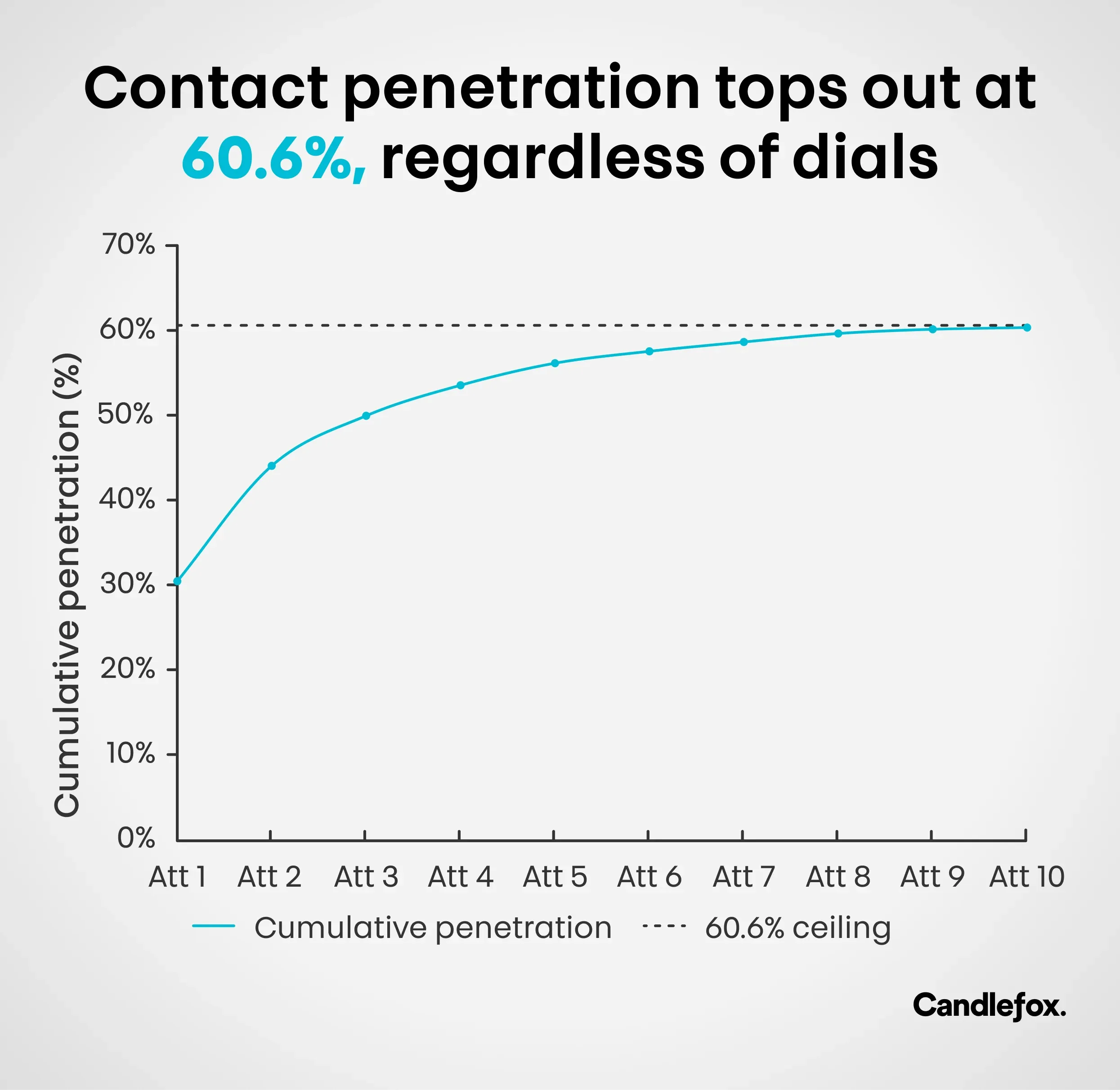
Contact penetration tops out at 60.6%, no matter how persistent the follow-up. That means roughly 39% of leads are never reached, regardless of how many times they’re dialled.
Most of that contact happens early. 73% of all contact ever made with a lead happens within the first two attempts, and attempts six through ten add just 3% more. Beyond a certain point, more dialling doesn’t buy more coverage.
2. It’s not the lead age that kills contact rate, it’s attempt number
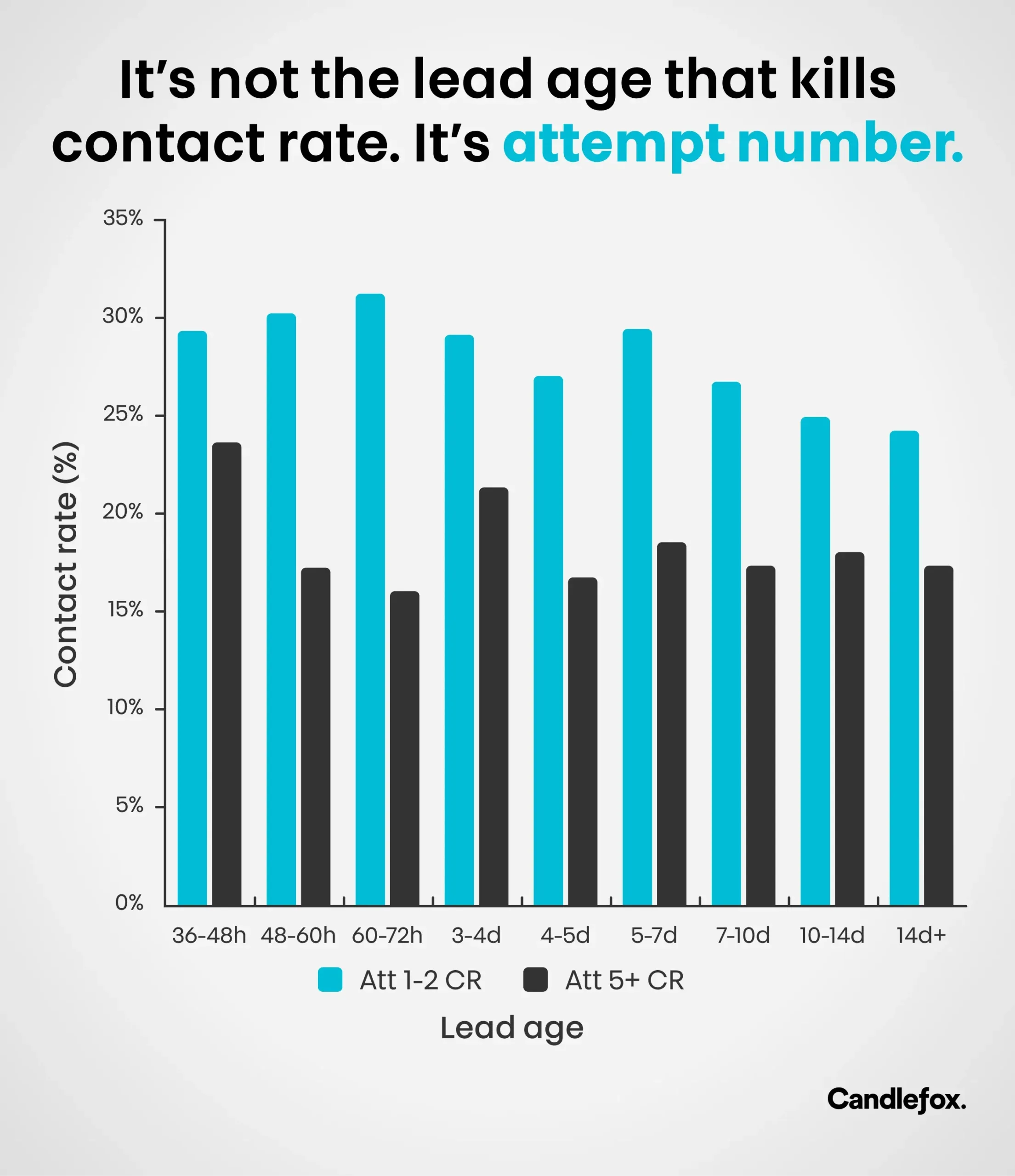
Hold the attempt number constant, and contact rate by age flattens to a stable 23 to 33%, regardless of how old the lead is. What looks like an age effect is really an attempt effect: young leads are usually on attempt one or two, while older leads have already burned through several. Attempt number, not age, is doing the work.
3. Speed matters, but the window is much smaller
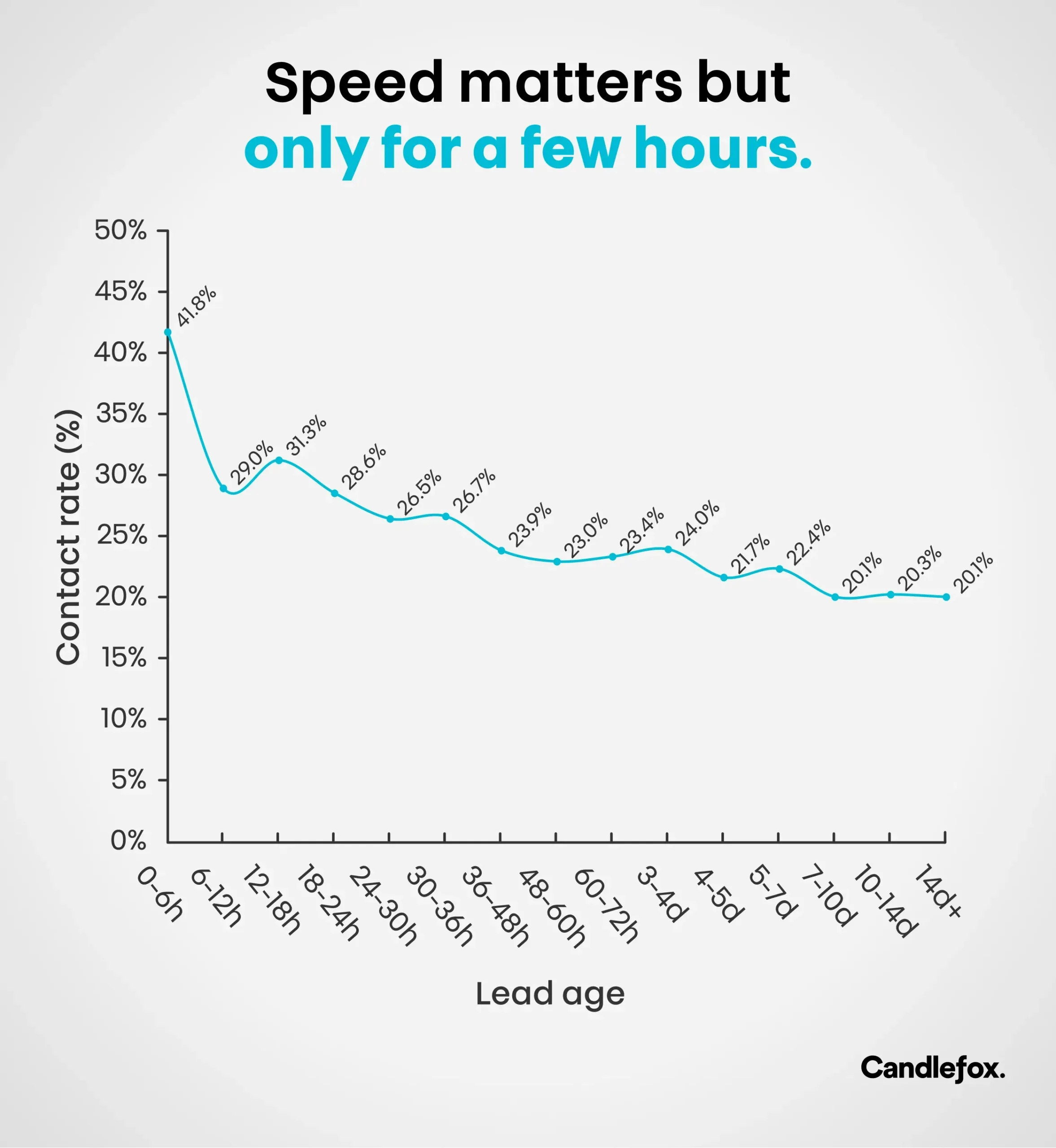
Contact rate peaks fast and fades fast: 41.8% in the first six hours after a lead arrives, plateauing at roughly 20% by hour five and staying flat from there.
Once a lead is reached, though, speed stops mattering for conversion. It holds steady at 12 to 14%, whether that first contact happens in hour one or day five. In other words, speed determines whether you reach the lead at all, not whether they convert once you do.
4. The best callback window is barely being used
A callback within four hours of a no-answer gets you a 32% contact rate. It’s statistically identical to a first attempt. Wait longer, and it drops to 17-20%.
Despite that, only about 19% of callbacks currently land inside the four-hour window. The median gap between call attempts is 22.9 hours, closer to one call per lead per day than the three-a-day cadence many teams assume they’re running.
5. Weekends are a coverage gap, not a demand gap
Weekend leads convert at roughly the same rate as in-hours leads when they’re reached in time (7.98% within 12 to 24 hours, versus a 7.97% in-hours average). The demand is clearly there.
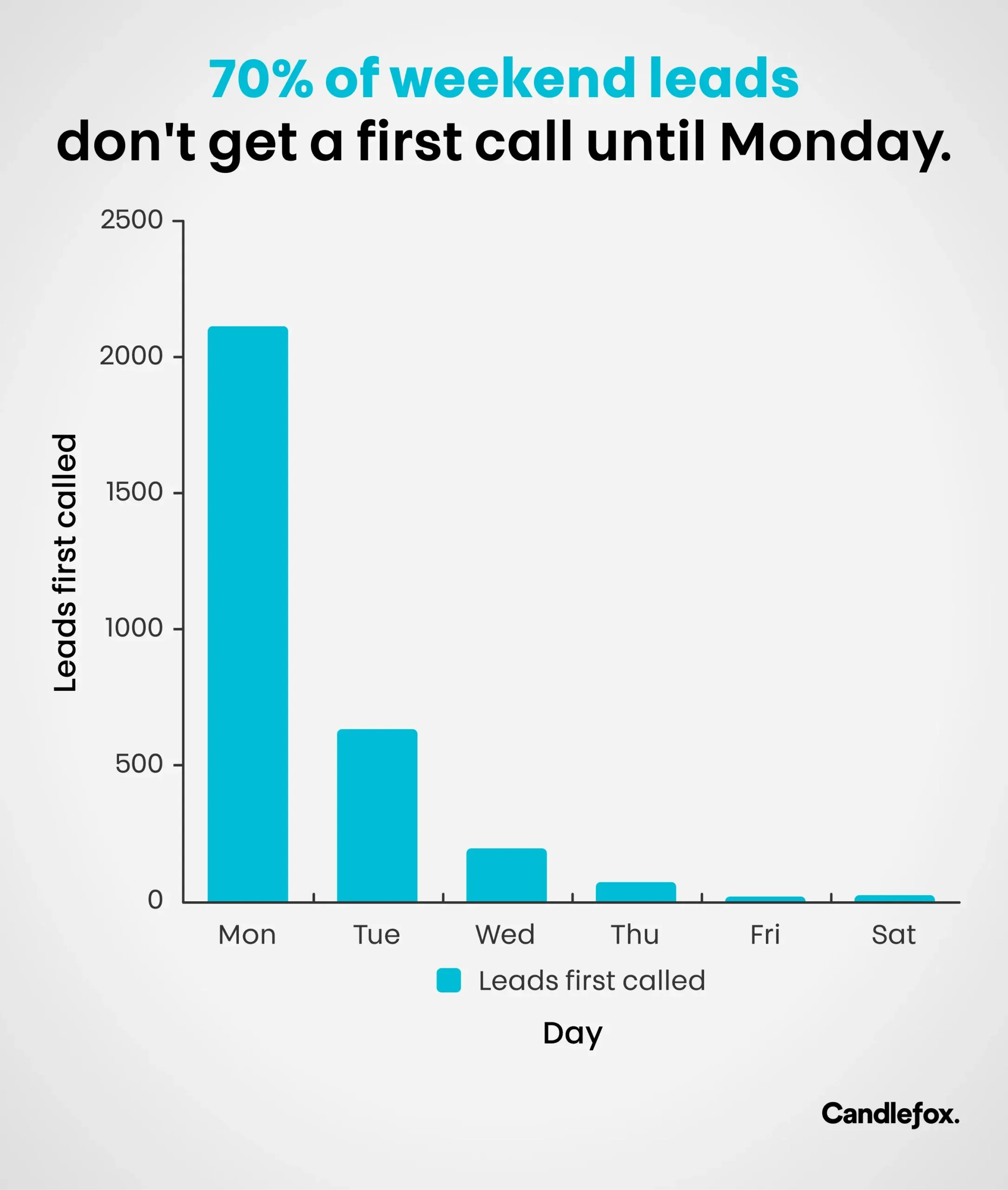
The coverage isn’t. Leads arriving outside business hours make up 59.4% of the pipeline, the majority of it, yet 70% of weekend leads don’t get a first call until Monday. By then, they’re 24 to 66 hours old.
Two populations, two different fixes
Put all of this together, and the “unreachable” leads split into two distinct groups, each needing a different response.
| Timing-solvable | Channel-resistant | |
|---|---|---|
| Who they are | OOH and weekend leads who are reachable, just not called in the right window. | Roughly 39% of leads who won’t answer an unknown number, regardless of timing |
| What the data shows | Contact rate for OOH leads called within 6 hours (64.9%) nearly matches in-hours performance | Contact penetration is flat at roughly 61% from attempt one through ten |
| The fix | Faster, better-timed calling | A different channel like SMS, email or WhatsApp to capture channel preference and keep the lead warm. |
The takeaway
None of this is solved by working harder or dialling more. A narrow four-hour window carries disproportionate weight, and a meaningful share of the pipeline needs a different channel entirely to be reached at all.
For an enrolment team, the fix isn’t “call more.” It’s calling smarter within the first two attempts, hitting the four-hour callback window without relying on agent memory, and routing channel-resistant leads to SMS or email instead of a fifth wasted dial. Get those three things right, and coverage moves without adding a single extra hour of agent time.
Where GabbyAI fits
Closing this exact gap, between when a lead arrives and when someone finally reaches them, is one of the core problems our new AI enrolment agent, GabbyAI, is built to solve:
- Catches leads the moment they arrive, including out of hours and on weekends, so the 60-hour-old Monday callback stops happening
- Triggers callbacks within the four-hour window automatically, no longer dependent on an agent remembering to circle back
- Flags channel-resistant leads for SMS or email follow-up instead of wasting another attempt on a channel that isn’t working for that lead
If inconsistent lead flow is costing you enrolments, the fix likely isn’t more effort from your team. It’s better timing and the right channel for the right lead.
Curious to learn more about GabbyAI?

Meghan Fernandes
Junior Content Specialist
Meghan Fernandes is a Content Writer at Candlefox, the team behind GabbyAI. Her work keeps RTOs and education providers informed on industry trends and information, offering useful insights on AI adoption and enrolment performance.